Article: How to Layer Hunting Clothes Without Restricting Movement

How to Layer Hunting Clothes Without Restricting Movement
Start With a Comfortable Base Layer
The layer closest to your skin has an important job: managing moisture.
During active hunts or long walks, sweat can accumulate quickly underneath heavier clothing.
A lightweight base layer made from moisture-managing fabric can help move that moisture away from the skin.
For warmer early-season conditions, your hunting shirt itself may effectively serve as your primary layer.
Look for fabrics that are:
- lightweight
- breathable
- quick drying
- comfortable against the skin
- flexible enough for unrestricted movement
Avoid making the first layer unnecessarily bulky.
Everything you add afterward will increase the overall thickness of your clothing system.
Add Insulation Only When You Need It
The middle layer provides warmth.
How much insulation you need depends heavily on the weather, activity level, and style of hunting.
A hunter sitting still for several hours may need considerably more insulation than someone continuously moving through the woods.
Fleece and other lightweight insulating garments are commonly used because they can add warmth without the weight of a heavy jacket.
But there's an important rule:
Don't dress for how cold you feel before you start walking.
If you're comfortable and warm before a strenuous hike to your hunting location, you may become overheated once you start moving.
Whenever practical, carry an insulating layer and put it on after reaching your position.
Your Outer Layer Should Protect Without Adding Unnecessary Bulk
The outer layer deals directly with the environment.
Depending on conditions, that might mean protection from:
- wind
- light rain
- brush
- cold
- changing vegetation
It is also usually the layer where camouflage matters most.
The challenge is finding enough protection without turning your clothing into a bulky shell that restricts movement.
This becomes especially important for bowhunters.
Excess fabric around the arms and chest can interfere with a smooth draw, while oversized sleeves may create unwanted contact or noise.
Choose an outer layer that leaves room underneath for necessary insulation but doesn't hang loosely around the body.
Don't Overlook Early-Season Hunting
Layering isn't only a cold-weather strategy.
It also matters during warm early-season hunts.
Dove hunting, early deer seasons, and some other hunts can take place while daytime temperatures remain relatively high.
In these conditions, the problem isn't staying warm.
It's staying comfortable without giving up coverage.
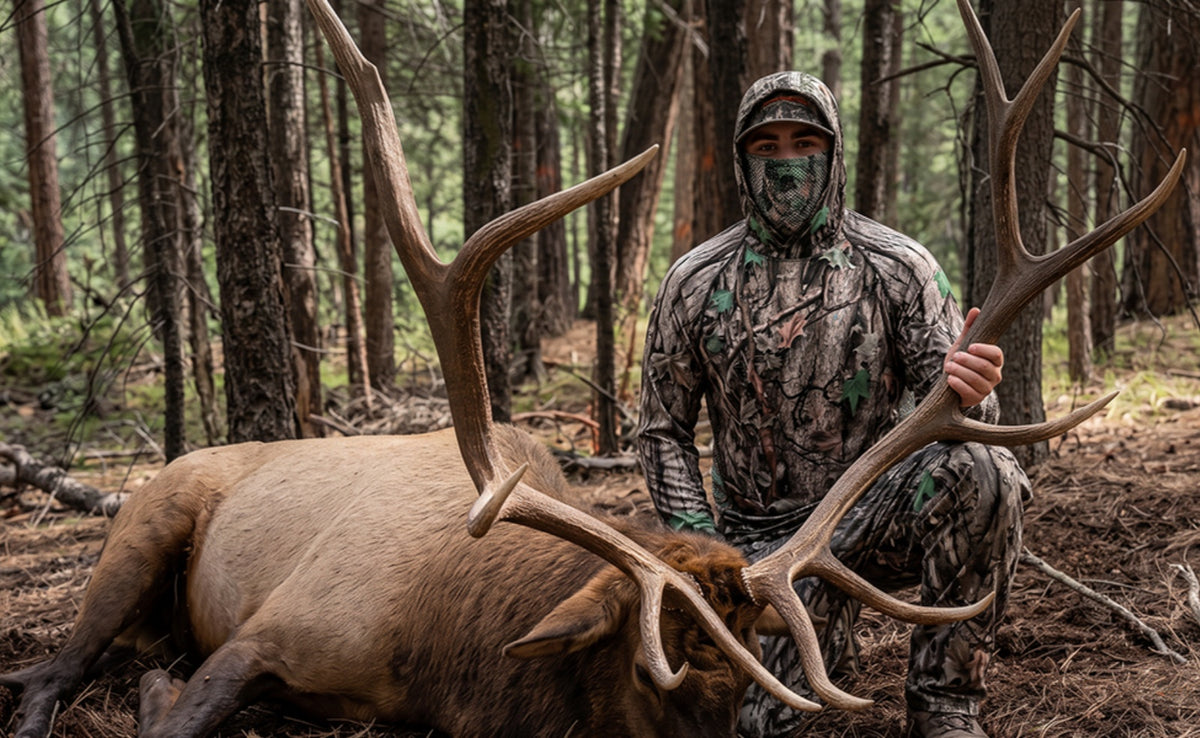
A lightweight long-sleeve camouflage hunting shirt can provide coverage while avoiding the bulk associated with traditional cold-weather hunting clothing.
Features such as breathable fabric, ventilation panels, and moisture management become especially valuable here.
When conditions cool in the morning or evening, you can simply add another layer.
Your Hunting Clothes Should Move With You
A common layering mistake is evaluating clothing while standing still.
Try moving instead.
Before heading into the field, perform a few basic movements while wearing your complete hunting setup.
Raise both arms.
Reach forward.
Squat.
Turn your torso.
Shoulder your firearm.
If you bowhunt, go through your normal drawing motion.
Your clothing shouldn't pull tightly across the shoulders or force you to compensate for restricted movement.
Pay particular attention to the shoulders, elbows, and underarms.
These areas experience considerable movement while hunting.
Integrated Face Coverage Can Simplify Your Setup
Face concealment often becomes another separate piece of hunting equipment.
Depending on the type of hunting, you might carry a face mask, neck gaiter, hat, and hood in addition to your normal clothing.
An integrated face covering can simplify that setup.
A lightweight camouflage hoodie with built-in face coverage allows you to pull the covering into place when concealment matters and lower it when you don't need it.
This can be particularly useful for turkey hunting and other situations where exposed skin may become noticeable.
The important part is breathability.
A face covering that becomes excessively hot or uncomfortable will probably spend more time pulled down than covering your face.
Avoid Wearing Every Layer From the Beginning
More clothing doesn't automatically mean better preparation.
Overdressing while walking into your hunting location is one of the easiest ways to become sweaty.
A better approach is to start slightly cool.
As your body warms from movement, you'll become comfortable naturally.
Once you reach your location and your activity level decreases, add your insulating layer.
This simple adjustment can make a major difference during long sits.
Pay Attention to Your Hands, Head, and Neck
Your torso gets most of the attention when building a hunting clothing system, but smaller pieces can dramatically change comfort.
Gloves, hats, neck gaiters, and face coverings are relatively easy to add or remove.
That makes them useful for fine-tuning your setup without changing your entire outfit.
During warmer conditions, lightweight sun or hunting gloves can provide coverage without the insulation of heavy gloves.
As temperatures drop, they can be replaced with warmer options.
Think of these accessories as adjustable parts of the overall layering system rather than separate pieces of gear.
Keep Your Camouflage Layers Consistent With the Environment
Not every layer needs exactly the same camouflage pattern.
Your base layer may barely be visible.
The outermost visible areas matter much more.
When combining hunting clothing, concentrate on the parts that animals are most likely to see:
torso, arms, head, hands, and face.
Your visible camouflage should broadly match the environment you're hunting in.
For example, bark and branch patterns can work naturally in mature timber, while lighter brown and olive combinations may blend better around field edges and dry vegetation.
Perfect pattern matching between every garment isn't necessary.
Breaking up your overall human silhouette is more important.
Build Your System Around the Hunt
There is no universal hunting layering system because hunters face very different conditions.
A simple way to think about it is:
Warm early season:
Lightweight camouflage shirt + optional face coverage.
Cool morning / warm afternoon:
Lightweight hunting shirt + removable mid-layer.
Cold stationary hunt:
Base layer + insulation + weather-resistant outer layer.
Active cold-weather hunt:
Moisture-managing base + lighter insulation + breathable outer layer.
The more active you expect to be, the more important moisture management becomes.
The more stationary you expect to be, the more important insulation becomes.
Don't Forget Noise
Hunting clothing doesn't only need to feel comfortable.
It also needs to stay relatively quiet.
Several loose layers rubbing against one another can create more noise than expected.
Before hunting, move around while wearing your full setup.
Listen when you:
- raise your arms
- turn your torso
- reach into pockets
- pull up your hood
- adjust your face covering
A garment that seems quiet by itself may behave differently when worn underneath a jacket or vest.
Pack for Changes, Not Just the Forecast
Weather forecasts are useful, but hunting creates its own microconditions.
You may begin walking before sunrise, sit in shade for several hours, move into direct sunlight, encounter wind on exposed terrain, and finish the day after temperatures have fallen again.
That is why flexibility matters.
A good hunting clothing system doesn't attempt to predict one perfect temperature.
It gives you enough options to adjust throughout the day.
Whenever possible, choose layers that are lightweight enough to pack when you don't need them.