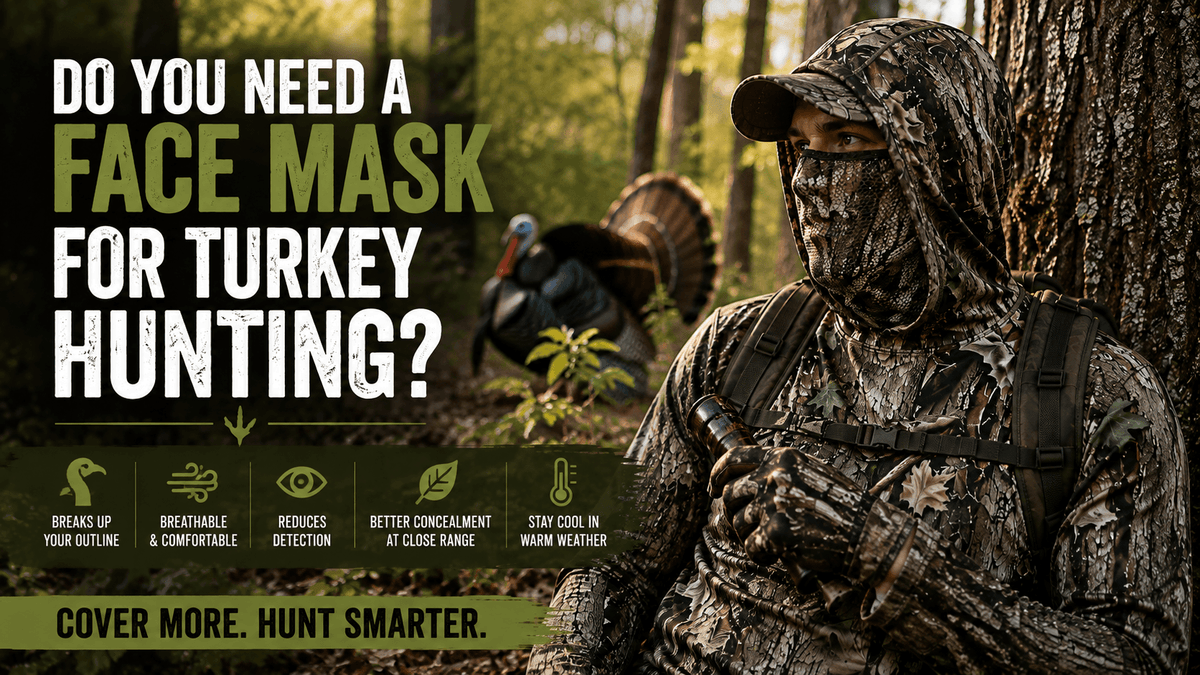
Do You Need a Face Mask for Turkey Hunting?
Why Face Concealment Matters for Turkey Hunting
Wild turkeys rely heavily on their eyesight.
Unlike hunting situations where you may be able to get away with more movement, turkey hunting often rewards hunters who can remain concealed and minimize sudden visual changes.
That means camouflage isn't just about matching the color of the woods.
It's also about breaking up:
- Your outline
- Exposed skin
- Movement
- Contrast between you and the background
Your face can be one of the most noticeable areas.
Think about sitting against a dark tree trunk while wearing woodland camouflage.
Your torso blends into the bark.
Your arms blend into surrounding vegetation.
Then there's a relatively bright patch of exposed skin above the collar.
A lightweight face covering helps reduce that contrast.
Face Masks Aren't Just About Color
One mistake hunters sometimes make is thinking camouflage works simply because everything is brown or green.
Effective concealment is more complicated.
Animals can notice shape and movement, not just color.
Your face has a recognizable shape, and hunters naturally move their heads frequently:
looking toward a sound,
checking another direction,
watching a decoy,
or preparing for a shot.
A camouflage face covering can help break up some of those recognizable visual features.
It won't make movement invisible.
But combined with good positioning and movement discipline, it can make your overall profile less obvious.
What Type of Turkey Hunting Face Mask Works Best?
There isn't one perfect option for every hunter.
You'll generally see several approaches.
Full Face Masks
These provide the most coverage.
They can be useful when concealment is the priority, but heavier versions may become uncomfortable during warmer hunts.
Mesh Face Masks
Mesh designs are especially useful when temperatures begin rising.
They provide visual coverage while allowing more airflow than heavier fabric.
For spring and early-season hunting, this can be a practical compromise between concealment and comfort.
Face Paint
Some hunters prefer camouflage face paint because there's no additional fabric covering the face.
It can work well, but it also requires application and cleanup.
Integrated Face Coverings
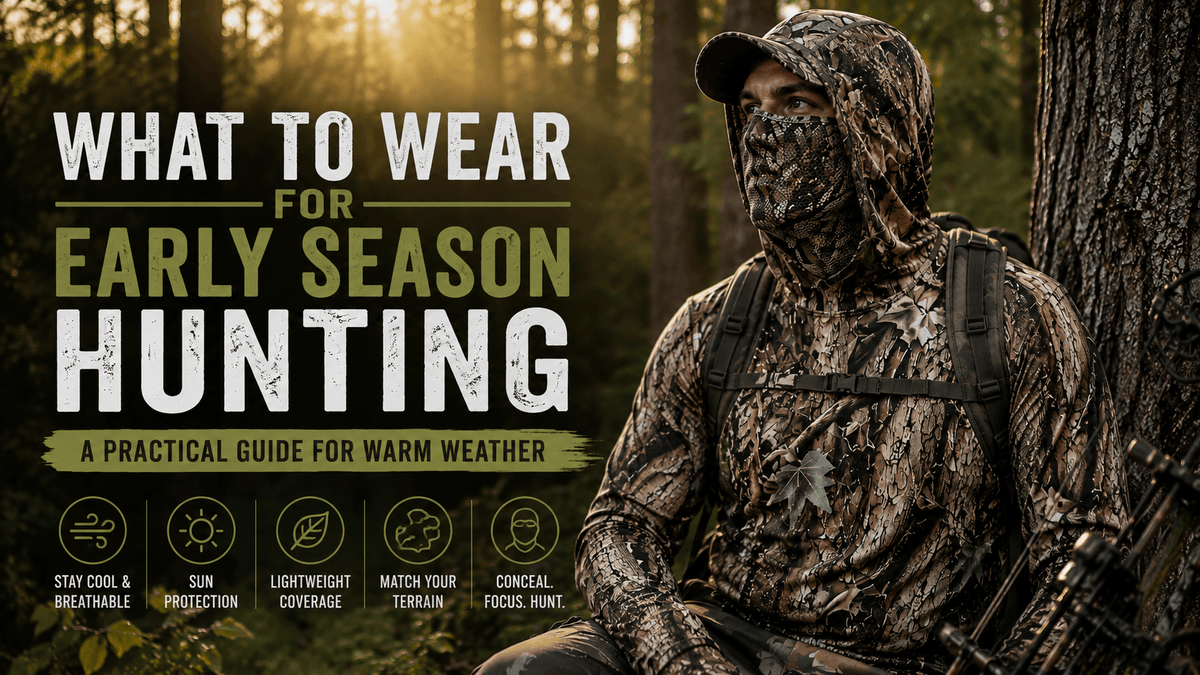
Another option is a hunting hoodie with the face covering built directly into the hood.
This approach eliminates a separate piece of gear.
When you don't need the face covering, it stays out of the way.
When you move into position, you can pull the hood and face covering into place.
For hunters trying to keep their setup simple, this can be particularly convenient.
Why Breathability Matters
Face coverage becomes much less useful if you're constantly pulling it down because you're overheating.
That's especially relevant during warm-weather turkey hunting.
Spring mornings can begin cool, but temperatures may rise quickly after sunrise.
You may also spend considerable time walking:
through woods,
along field edges,
up hills,
or between calling locations.
A thick face covering can trap heat and moisture.
That's why lightweight or mesh construction makes sense for warmer conditions.
The principle is simple:
Use enough material for concealment without adding unnecessary insulation.
The same rule applies to the rest of your hunting clothing.
Face Mask + Hood: A Simple Combination
A hood can add another layer of concealment around the head and neck.
Used together, a hood and face covering help reduce the visible transition between your head, neck, and upper body.
That's particularly useful when sitting against:
tree trunks,
brush,
fallen timber,
or wooded field edges.
Instead of having a camouflage shirt ending at the neck and exposed skin beginning immediately above it, the camouflage pattern continues upward.
This creates a more consistent silhouette.
Don't Forget Your Hands
If you're covering your face for concealment, think about your hands too.
Hands move frequently during a turkey hunt.
You may be:
adjusting a call,
using binoculars,
moving your firearm or bow,
or repositioning yourself.
Lightweight camouflage gloves can help reduce exposed skin without adding much bulk.
For warm conditions, avoid unnecessarily heavy gloves.
As with your face covering, breathability and comfort matter.
Should You Match Your Face Mask to Your Camo?
Ideally, your face covering shouldn't create a completely different visual block from the rest of your hunting clothing.
But an exact pattern match isn't always necessary.
The larger goal is to keep the colors and contrast appropriate for the environment.
For example, in a wooded environment with:
- Gray tree bark
- Brown leaves
- Dark shadows
- Small patches of green vegetation
a muted woodland or bark-inspired face covering will generally make more sense than an extremely bright green pattern.
Think about the entire hunting setup rather than individual pieces.
Your:
hood + face + shirt + gloves + pants
should work together against the background.
When Is a Face Mask Most Useful?
A face covering becomes especially useful when you're hunting without a blind.
If you're sitting directly against a tree or natural cover, your clothing becomes your primary concealment.
It can also be helpful when:
You're hunting close.
The closer a bird gets, the more important movement and concealment can become.
You're bowhunting.
Drawing a bow requires considerably more movement than pulling a trigger, making overall concealment especially valuable.
You're hunting open timber.
Limited vegetation may leave less natural cover around your upper body.
You're calling from the ground.
When you're exposed rather than enclosed inside a blind, covering your face can help complete your camouflage setup.
When Might You Not Need One?
A face mask isn't mandatory for every turkey hunting situation.
For example, if you're hunting entirely from a well-concealed ground blind, exposed skin may be much less visible.
Some hunters also simply prefer face paint.
And depending on your position, lighting, distance, and natural cover, a face covering may provide only a small advantage.
The important point is not:
“Every turkey hunter must wear a face mask.”
It's:
“Think about whether your exposed face creates unnecessary contrast in your particular hunting setup.”
That is a much more useful way to approach concealment.
What About Warm-Weather Hunting?
This is where clothing design becomes particularly important.
Imagine you're walking for 20 minutes to reach a hunting location on a warm morning.
You're wearing:
a heavy camouflage jacket,
a separate balaclava,
a hat,
and gloves.
By the time you arrive, you're already hot.
Now compare that with:
a lightweight camouflage hoodie,
breathable side panels,
a lightweight integrated face covering,
and thin gloves.
Both setups provide coverage.
But the second requires fewer individual pieces and is better suited to warm conditions.
For mobile hunters, simplifying gear can make a noticeable difference.
An Integrated Face Cover Can Reduce Gear Clutter
There's another practical advantage to having the face covering attached to your hunting shirt:
you can't leave it at home.
Small hunting accessories are easy to forget.
Gloves.
Calls.
Face masks.
Head nets.
When the face covering is built into the garment, it's already part of your hunting setup.
That can be useful for hunters who prefer keeping their gear simple.
Instead of carrying another accessory, you have concealment available whenever you need it.
A Simple Warm-Weather Turkey Hunting Setup
For many warmer turkey hunts, your clothing system doesn't need to be complicated.
A practical setup might look like:
Upper body: Lightweight camouflage hoodie or long-sleeve hunting shirt
Face: Breathable mesh face covering
Hands: Lightweight camouflage gloves
Lower body: Breathable hunting pants
Feet: Boots appropriate for the terrain
Extra layer: Lightweight packable shell if temperatures change
Then adjust based on weather, vegetation, insects, and how much walking you expect to do.
The key is flexibility.
You shouldn't need cold-weather hunting clothing simply because you're hunting.
Concealment Still Starts With Staying Still
A face mask can help.
Camouflage can help.
A hood can help.
But none of them replace good hunting habits.
If a turkey is close, sudden movement can still reveal your position regardless of what camouflage pattern you're wearing.
That's why clothing should support your hunting—not become something you're constantly adjusting.
Comfort matters here.
If your face covering is:
too tight,
too hot,
constantly sliding,
or restricting your vision,
you'll naturally touch and adjust it more frequently.
That's exactly what you don't want.
Choose something comfortable enough that you can put it on and largely forget about it.
Safety Comes Before Camouflage
There's one point more important than concealment:
being identifiable as a hunter when safety requires it.
Turkey hunting presents unique safety considerations because hunters may imitate turkey sounds and other hunters may be nearby.
Never use camouflage in a way that conflicts with local hunting regulations or established hunter-safety practices.
Know your target.
Know what's beyond it.
And check the hunting regulations for your specific state before heading into the field.
No camouflage advantage is worth compromising safety.