How to Choose the Right Camo Pattern for Hunting
1. Start With the Environment
Before choosing a pattern, think about where you'll actually spend most of your hunting time.
This is more useful than asking:
"What's the best camo pattern?"
A better question is:
"What's the best camo pattern for where I hunt?"
Let's look at several common environments.
Hardwood Forests
Hardwood forests are one of the most natural environments for traditional woodland camouflage.
You'll commonly encounter combinations of:
- Tree bark
- Branches
- Brown leaves
- Gray wood
- Green foliage
- Dark shadows
Patterns incorporating realistic bark, leaves, and irregular branches can blend naturally into these environments.
During early season, when substantial green vegetation remains, camouflage containing muted greens can work particularly well.
As the season progresses, browns, grays, and dried-leaf tones become increasingly relevant.
Good pattern characteristics:
Bark + branches + leaves + muted green/brown tones
2. Early Season vs. Late Season Camo
One of the easiest mistakes is wearing the same camouflage throughout the entire hunting season without considering how much the landscape changes.
Early Season
During early season, vegetation may still be relatively dense.
Depending on your location, the environment may contain:
- Green leaves
- Dense vegetation
- Dark tree trunks
- Heavy shadows
- Green undergrowth
A woodland camouflage pattern containing green alongside bark and leaf elements can work well here.
But there's another consideration:
temperature.
Early-season conditions can still be warm.
That means choosing the right camouflage pattern isn't enough. The garment itself should also be lightweight and breathable.
Heavy hunting jackets may provide excellent camouflage but become uncomfortable when temperatures climb.
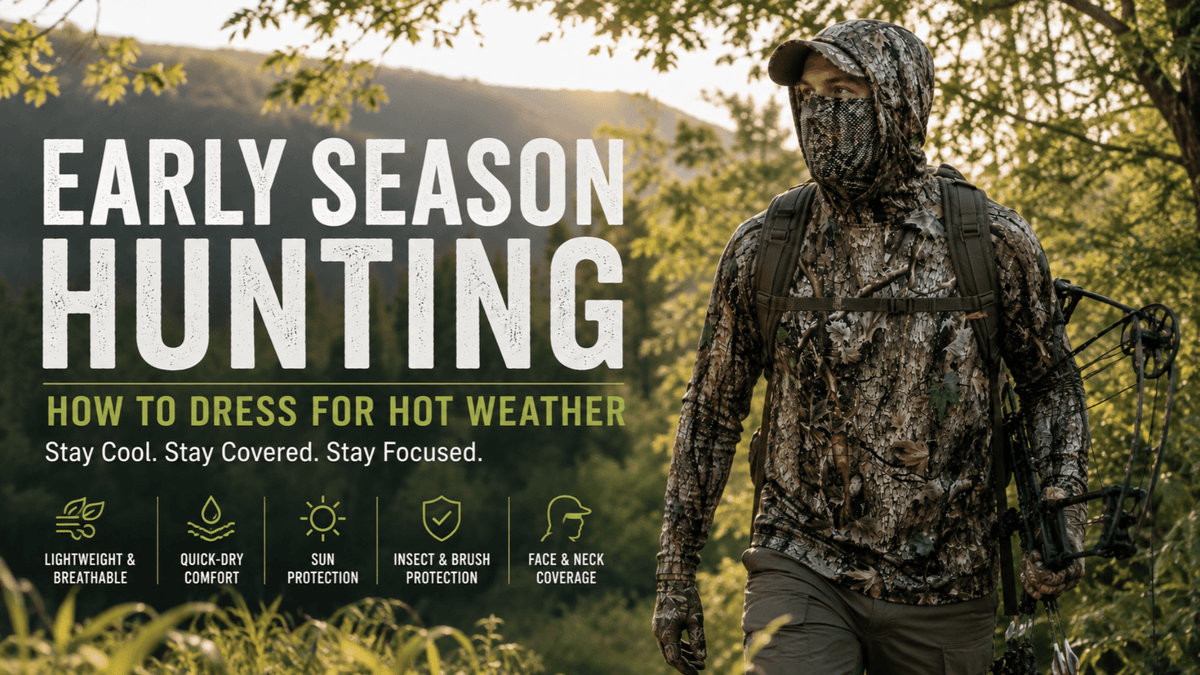
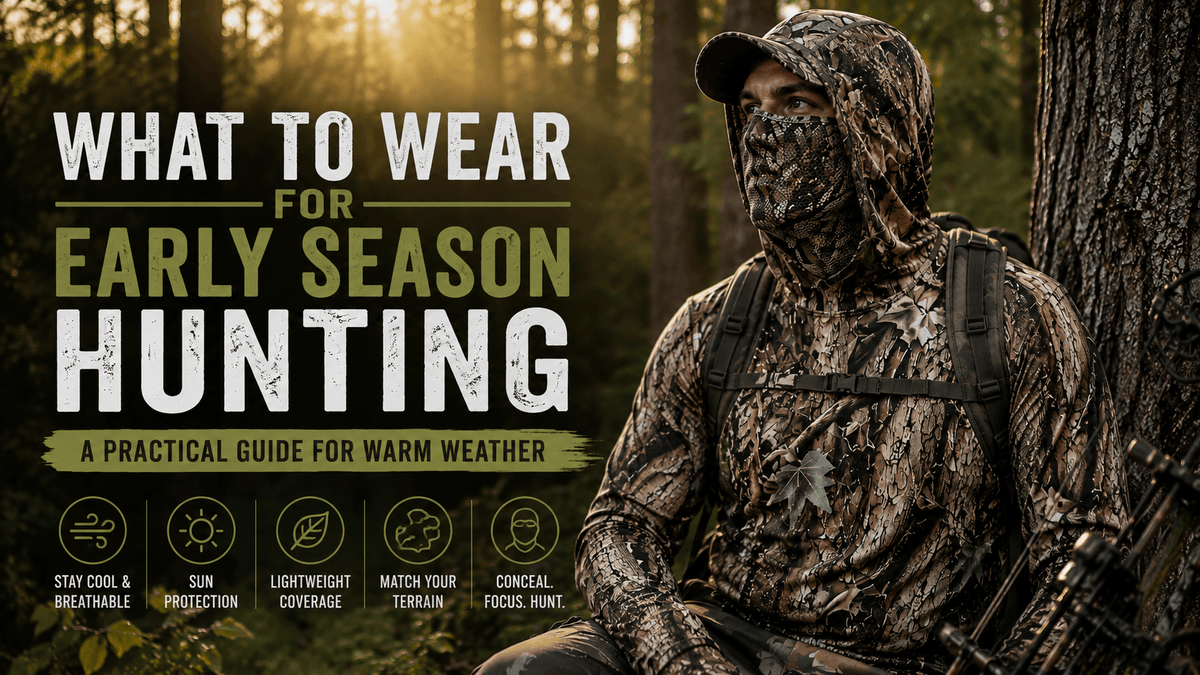
For warm-weather hunts, consider combining woodland camouflage with a lightweight hunting shirt or hoodie.
Mid Season
As temperatures drop and leaves begin changing, the landscape usually becomes more mixed.
Greens remain in some areas while brown, gray, tan, and dried vegetation become increasingly common.
This transitional period is where versatile woodland patterns can perform particularly well.
Patterns containing several natural tones rather than one dominant color can adapt better as the surrounding vegetation changes.
Late Season
Once leaves have fallen, the woods can look dramatically different.
Bright green camouflage that blended perfectly several weeks earlier may suddenly become much more noticeable.
Late-season environments often contain more:
- Gray
- Brown
- Tan
- Bare branches
- Tree trunks
- Dead vegetation
Patterns emphasizing bark, branches, and muted earth tones generally make more sense under these conditions.
Clothing requirements also change.
At this point, insulation and layering become increasingly important.
3. Camo for Deer Hunting
Whitetail deer hunting takes place across an enormous variety of environments, so there isn't one universal "deer hunting camo."
A hunter sitting in a hardwood tree stand has different needs from someone hunting around agricultural fields.
For woodland deer hunting, look for patterns that break up the upper-body silhouette against trees and branches.
Bark-based patterns are particularly logical when you're positioned near tree trunks.
Tree stand hunters
Think about how your camouflage looks from the animal's perspective.
You may have:
- Tree trunk behind you
- Branches around you
- Open space below
- Changing light throughout the morning
A pattern with varied shapes and contrast can help prevent your torso from appearing as one large continuous object.
4. Camo for Turkey Hunting
Turkey hunting places particularly strong emphasis on concealment.
Turkeys have excellent vision and can notice movement quickly.
Because hunters may encounter birds at relatively close distances, exposed areas of the body become more important.
That includes:
- Face
- Neck
- Hands
- Arms
For this reason, turkey hunters commonly use more complete camouflage coverage.
A camo hunting hoodie with an integrated face cover can be useful because it allows you to cover more exposed skin without carrying a separate mask.
Good turkey camo characteristics:
- Woodland colors
- Detailed vegetation patterns
- Long sleeves
- Face coverage
- Minimal exposed skin
The exact pattern should still reflect the vegetation where you're hunting.
5. Camo for Dove Hunting
Dove hunting is different.
Hunters often spend time around:
- Agricultural fields
- Field edges
- Brush
- Dry vegetation
- Open terrain
You aren't necessarily trying to disappear against a dense forest background.
Instead, avoiding a strong human silhouette and minimizing unnecessary movement can be particularly important.
Earth tones, muted camouflage, and patterns matching surrounding vegetation can all work.
Because dove seasons often begin during warm weather, clothing weight becomes especially important.
A lightweight long-sleeve camo shirt can provide coverage without requiring heavy traditional hunting clothing.
6. Camo for Duck and Waterfowl Hunting
Waterfowl environments can look completely different from deer woods.
Instead of tree bark and leaves, hunters may be surrounded by:
- Reeds
- Marsh grass
- Cattails
- Mud
- Open water
- Dead vegetation
This is why camouflage patterns designed around grassland or marsh vegetation can be more appropriate than dark woodland patterns.
Your surroundings should determine your camouflage.
If you're sitting in tall tan reeds, a heavily green woodland pattern may create unnecessary contrast.
7. Realistic Camo vs. Abstract Camo
Modern hunting camouflage generally falls somewhere between two approaches.
Realistic camouflage
These patterns reproduce recognizable natural objects:
- Leaves
- Bark
- Branches
- Grass
- Trees
The advantage is intuitive.
If you're surrounded by bark and leaves, wearing bark and leaves seems logical.
These patterns are particularly popular among hunters who prefer traditional woodland camouflage.
Abstract camouflage
Other patterns rely more heavily on shapes, contrast, and color blocks rather than photographic representations of vegetation.
Their purpose is often to disrupt the human silhouette rather than reproduce a specific tree or leaf.
Neither approach is automatically better.
The environment and hunting situation matter more than whether the camouflage looks impressive up close.
8. Don't Judge Camo From Three Feet Away
This is an important point.
Most people evaluate camouflage while holding the garment directly in front of them.
That's not necessarily how an animal will see it.
Take several steps away.
Then look again.
Better yet, place the garment against the type of environment where you'll actually hunt and view it from:
10 yards → 20 yards → 40 yards.
Ask yourself:
Can I still immediately identify the human outline?
Sometimes extremely detailed camouflage looks excellent up close but merges into one dark mass at distance.
Variation in scale and contrast can help break up larger shapes.
9. Movement Matters More Than Perfect Camouflage
Even excellent camouflage can't compensate for constant movement.
Turning your head rapidly, raising your arms, adjusting equipment, or walking at the wrong moment can reveal your position.
Think of camouflage as one part of concealment rather than the entire system.
Good concealment combines:
Pattern + position + background + movement control + coverage.
This is particularly important when hunting animals with strong visual awareness.
10. Don't Forget Your Face and Hands
You can wear camouflage from your shoulders to your boots and still leave two obvious areas exposed.
Your face and hands.
Skin can contrast strongly with the natural environment around you, especially when the rest of your clothing is dark or patterned.
This is one reason face coverings are commonly used in situations where concealment matters.
A lightweight integrated face mask can be particularly practical during warm-weather hunts because you can raise it when needed and lower it when you don't need complete coverage.
Gloves can provide similar coverage for the hands.
11. Comfort Still Matters
There's little value in having a perfectly matched camouflage pattern if you're uncomfortable wearing it.
This becomes especially obvious during early-season hunting.
A hunter who is overheating is more likely to:
- Move unnecessarily
- Adjust clothing
- Remove layers
- Become distracted
That's why camouflage should never be evaluated separately from the garment itself.
For warm conditions, look for hunting clothing that combines camouflage with:
- Lightweight fabric
- Breathability
- Quick-drying performance
- Comfortable movement
- Long-sleeve coverage
The objective isn't simply to look camouflaged.
It's to stay comfortable enough to remain still when it matters.
A Practical All-Around Woodland Option
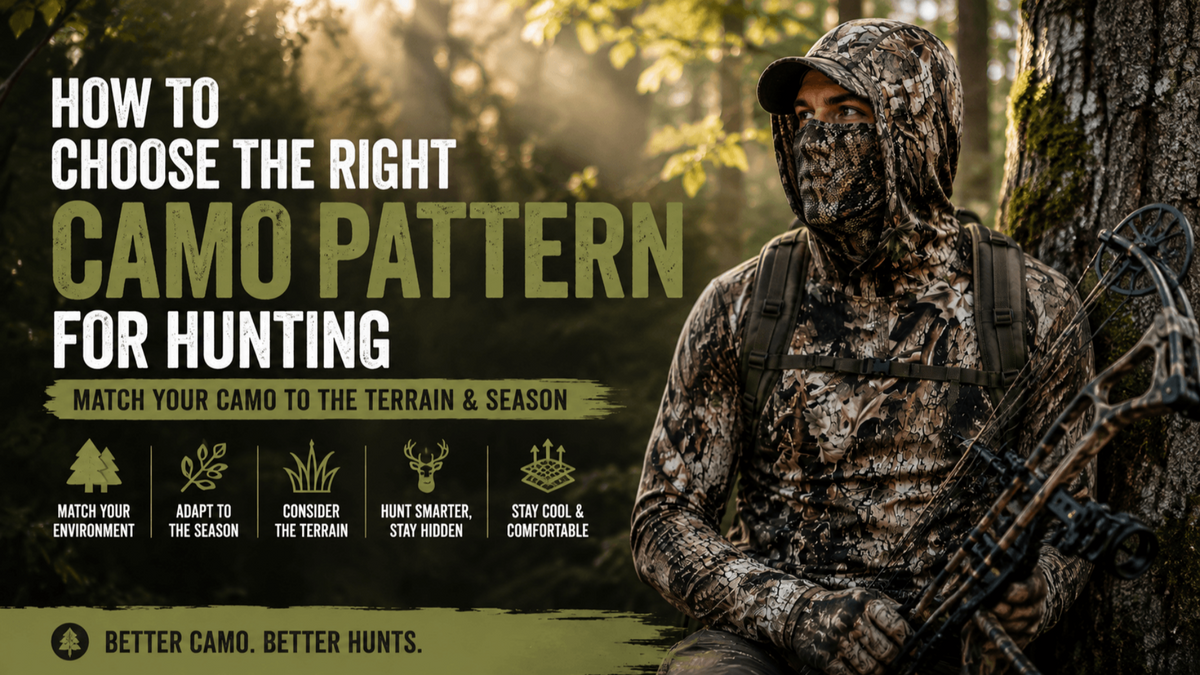
For hunters spending much of their time in wooded environments, a mixed bark-and-leaf pattern provides a versatile starting point.
Rather than relying entirely on green foliage, a combination of bark, branches, dried leaves, and muted green elements can work across changing early-to-mid-season vegetation.
For warmer hunts, WELIGU's Men's Camo Hunting Hoodie with Face Cover combines this type of woodland pattern with lightweight coverage.
The integrated face cover can be raised when additional concealment is needed and lowered when it isn't.