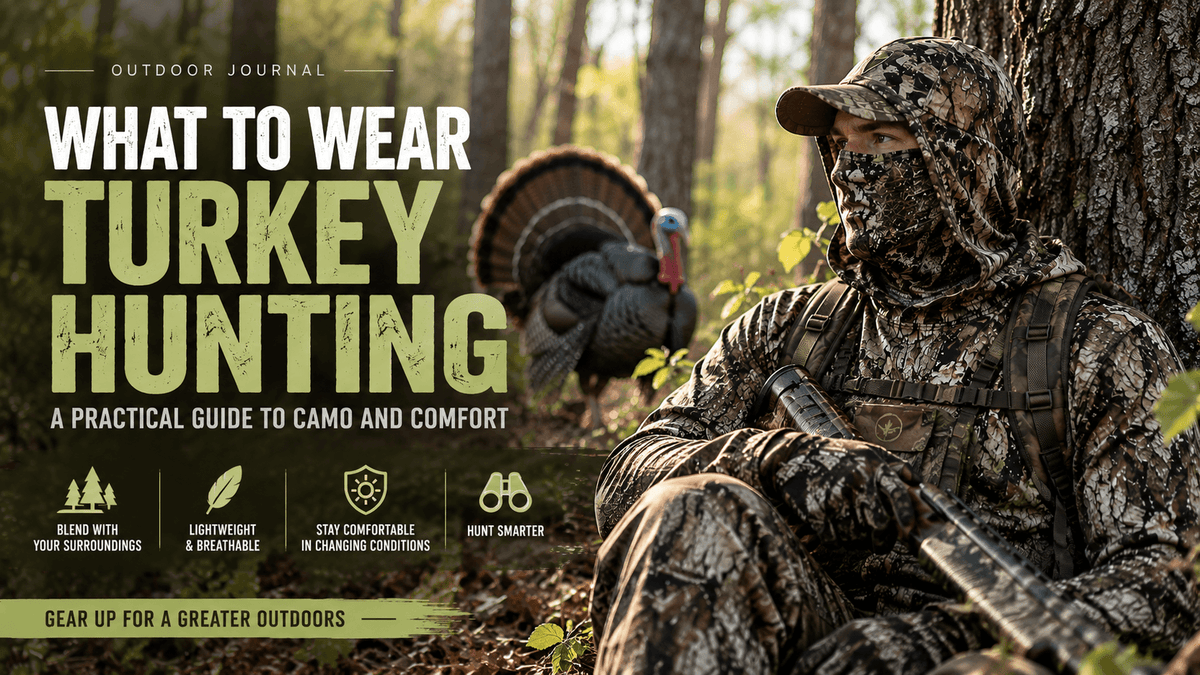
What to Wear Turkey Hunting: A Practical Guide to Camo and Comfort
Turkey hunting can make clothing choices surprisingly important.
One morning you might be sitting motionless against a tree in cool air. A few hours later, you could be walking through timber in warmer temperatures while carrying your gear.
And unlike some types of hunting where a little movement may go unnoticed, turkey hunting often puts a premium on staying concealed.
That means your clothing has several jobs to do at once.
It needs to help you blend into your surroundings, cover exposed skin, move comfortably, and adapt to changing conditions.
So what should you actually wear turkey hunting?
Here's a practical way to build your setup.
Why Clothing Matters for Turkey Hunting
Turkey hunting isn't just about wearing camouflage because that's what hunters traditionally wear.
Concealment has a practical purpose.
When you're sitting against a tree, your body creates shapes, colors, and movement that may contrast with the surrounding environment.
Good hunting clothing helps reduce those differences.
The goal isn't to become completely invisible.
It's to make yourself look less obviously human.
That usually means thinking about:
Color. Pattern. Coverage. Movement. Comfort.
All five matter.
1. Start With Camouflage That Matches Your Environment
There's no single "best turkey hunting camo" for every hunt.
The right pattern depends heavily on where you're hunting.
A dense green woodland in late spring looks very different from open timber earlier in the season.
Before choosing your clothing, look at the actual environment.
Early Spring
Vegetation may still be relatively sparse.
You may see plenty of:
- Gray bark
- Brown leaves
- Bare branches
- Dark timber
- Muted vegetation
Patterns incorporating bark, branches, brown, gray, and subdued green can work naturally in these environments.
Later Spring
As vegetation becomes greener, your surroundings may shift toward:
- Fresh leaves
- Green undergrowth
- Dense brush
- Dark shadows
A pattern with more muted greens may blend better.
The important point is simple:
Choose camouflage for the environment—not because the pattern looks good on a product page.
2. Cover Your Face
Your hunting shirt may blend beautifully into a tree trunk.
Your face probably doesn't.
When you're sitting in shade surrounded by bark, leaves, and vegetation, exposed skin can create noticeable contrast.
That's why face coverage is common in turkey hunting.
Hunters generally have several options:
- Face mask
- Neck gaiter
- Face paint
- Hood with face covering
A lightweight face covering can be especially useful because it provides concealment without requiring much additional gear.
But comfort still matters.
If the material becomes excessively warm or restricts breathing, you'll probably adjust it constantly.
And constant movement works against concealment.
3. Don't Forget Your Hands
Hands are easy to overlook.
They're also one of the parts of your body most likely to move.
You may be:
- Holding a call
- Adjusting equipment
- Repositioning your firearm
- Using binoculars
- Moving vegetation
Lightweight camouflage gloves can reduce the contrast between your hands and your surroundings.
For warmer conditions, breathable or lightweight gloves generally make more sense than heavy insulated versions.
4. Choose a Lightweight Hunting Shirt
A turkey hunting shirt doesn't need to feel like armor.
In many situations, lighter clothing offers advantages.
You're often alternating between sitting and walking.
A heavy top may feel comfortable while you're stationary early in the morning but become unpleasant once temperatures rise.
A lightweight long-sleeve hunting shirt or hoodie can provide:
- Arm coverage
- Camouflage
- Sun coverage
- Easier movement
- Less bulk
The fabric should also allow you to comfortably shoulder your firearm without pulling tightly across your back or shoulders.
Before hunting, test the shirt while wearing your normal gear.
Don't judge fit only while standing still.
5. Consider a Hunting Hoodie With Face Coverage
A lightweight camouflage hoodie can be particularly practical for turkey hunting.
The hood helps break up the outline around your head and neck.
Add an integrated or separate face covering, and much of the upper body can be concealed without requiring several independent pieces of gear.
This can simplify your setup.
However, there's an important distinction:
Lightweight hunting hoodie ≠ cold-weather hoodie.
For active or warmer hunts, heavy fleece may become uncomfortable quickly.
Choose the layer according to the weather and activity level.
6. Wear Quiet Clothing
Camouflage isn't very helpful if every movement makes noise.
When evaluating turkey hunting clothes, think about how the fabric behaves when you:
- Move your arms
- Sit down
- Walk through vegetation
- Reach for equipment
Some materials can produce noticeable rustling.
You don't necessarily need specialized silent fabric for every hunt, but avoiding excessively noisy clothing is a sensible precaution.
Try your clothing at home before heading into the woods.
If normal movements sound surprisingly loud in a quiet room, they'll probably sound loud in quiet timber too.
7. Use Layers Instead of One Heavy Garment
Spring hunting weather can change quickly.
Early mornings may feel cool.
By late morning or afternoon, temperatures can become considerably warmer.
Instead of wearing one heavy outer layer, consider a simple layering system.
Base layer
Something comfortable against the skin that manages moisture reasonably well.
Hunting shirt or hoodie
Your primary camouflage and coverage layer.
Optional outer layer
A lightweight jacket when conditions require it.
As temperatures rise, you can remove the outer layer without losing your camouflage.
This gives you more flexibility than committing to a heavy insulated hunting top.
8. Choose Pants for the Terrain
Your upper body often receives most of the attention when choosing camouflage.
But pants matter too.
The right choice depends partly on where you're hunting.
Think about:
- Brush
- Mud
- Wet vegetation
- Thorns
- Walking distance
- Temperature
For warmer conditions, excessively heavy pants can become uncomfortable during longer walks.
Neutral colors such as brown, olive, or tan may work in some environments even if your pants aren't covered in an elaborate camouflage print.
Full camouflage can provide additional concealment, but matching the surrounding environment remains more important than simply wearing camo everywhere.
9. Footwear Depends on Where You're Hunting
There isn't one universal turkey hunting boot.
Your terrain determines what you need.
Dry woodland may require something completely different from wet fields or muddy creek bottoms.
Consider:
Traction — Can you comfortably handle uneven terrain?
Water resistance — Are you expecting wet grass, mud, or shallow water?
Walking comfort — How far will you actually travel?
Temperature — Heavy insulated boots may be unnecessary in mild conditions.
Choose footwear for the hunt you're actually going on.
10. Use Natural Cover With Your Camouflage
Even excellent turkey hunting camo works better when paired with natural cover.
Instead of sitting in an exposed position, look for backgrounds such as:
- Large tree trunks
- Brush
- Fallen timber
- Dense vegetation
- Natural shadows
A tree can help break up your outline much more effectively than camouflage alone.
This is also why the pattern you choose should relate to your hunting position.
If you're sitting against rough gray-brown bark, a bark-and-branch camouflage pattern can make visual sense.
If you're surrounded by fresh green vegetation, a different pattern may work better.
11. Movement Can Give You Away
A hunter can wear excellent camouflage and still stand out through movement.
That's especially relevant when you're waiting for a bird to approach.
Try to keep frequently used equipment close enough that you don't need large movements to reach it.
Before settling into your position:
- Get comfortable
- Organize your calls
- Position your equipment
- Check your surroundings
- Make sure nothing restricts your movement
Once you're settled, minimizing unnecessary motion becomes easier.
Comfort actually contributes to concealment.
If your clothing is hot, tight, itchy, or restrictive, you'll naturally adjust it more often.
12. What to Wear Turkey Hunting in Warm Weather
Warm-weather turkey hunting requires a slightly different strategy.
Instead of adding more camouflage layers, focus on getting enough concealment with less bulk.
A practical setup might include:
Lightweight camo hoodie or long-sleeve shirt
Provides upper-body coverage without a heavy outer layer.
Lightweight face covering
Reduces exposed skin.
Thin hunting gloves
Covers your hands without unnecessary insulation.
Breathable hunting pants
Appropriate for the terrain.
Comfortable footwear
Matched to walking distance and ground conditions.
The objective is simple:
Stay covered without overheating.
13. What Should You Avoid Wearing Turkey Hunting?
A few clothing choices can work against you.
Bright Colors
Bright clothing can create unnecessary contrast with natural surroundings.
And turkey hunters should pay particular attention to color-related hunting safety guidance and current local regulations.
Heavy Clothing in Warm Conditions
Overheating leads to discomfort.
Discomfort leads to movement.
Movement makes concealment harder.
Restrictive Shirts
If you can't comfortably shoulder your firearm, the shirt isn't suitable simply because the camouflage looks good.
Extremely Noisy Fabric
You don't want every small adjustment producing unnecessary sound.
A Simple Turkey Hunting Clothing Checklist
You don't need an enormous wardrobe.
A straightforward setup could include:
| Item | Purpose |
|---|---|
| Lightweight camo shirt/hoodie | Concealment + coverage |
| Face covering | Reduce facial contrast |
| Lightweight gloves | Conceal moving hands |
| Hunting pants | Protection + mobility |
| Appropriate footwear | Terrain + comfort |
| Optional light outer layer | Cooler mornings |
Adjust the system according to weather and terrain.
Is Full Camo Necessary for Turkey Hunting?
This question doesn't have a perfect universal answer.
But turkey hunting generally places greater emphasis on concealment than many casual early-season hunts.
Covering your upper body, face, and hands can help reduce obvious visual contrast.
Still, camouflage shouldn't distract you from the bigger picture.
Good concealment also means:
Using natural cover.
Choosing a suitable background.
Limiting movement.
Setting up carefully.
Staying comfortable enough to remain still.
Camouflage supports those habits—it doesn't replace them.