When Does Dove Hunting Season Start? What Hunters Should Know
When Does Dove Season Usually Start?
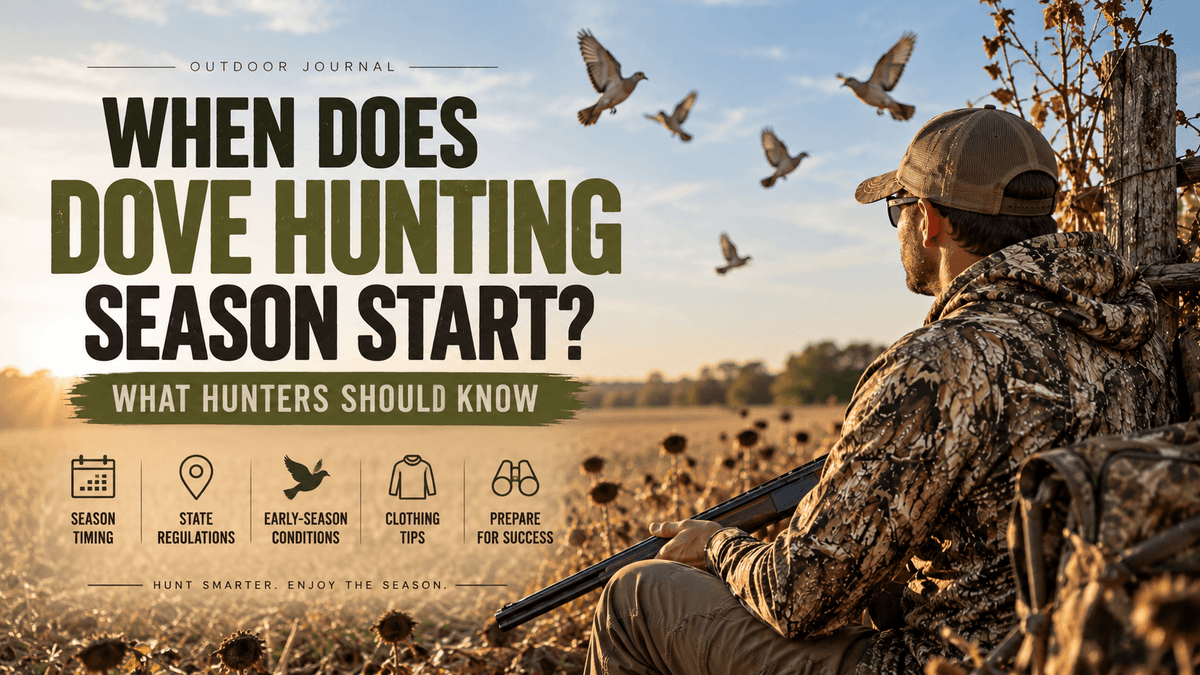
Across much of the United States, dove hunting is associated with late summer and early fall.
September is especially important.
In many areas, hunters think of the beginning of September as the traditional start of dove season.
But don't assume that the date you hunted last year—or the date used by another state—is automatically correct for your location this year.
Season dates can vary by:
- State
- Hunting zone
- Dove species
- Season segment
- Wildlife-management regulations
Some states also divide their dove season into multiple portions rather than running one continuous season.
That's why checking current regulations should always be part of your opening-day preparation.
Why Dove Season Dates Vary
Doves are migratory birds.
Because of that, their hunting seasons operate differently from many resident game species.
Federal wildlife authorities establish broader migratory-bird hunting frameworks, while state wildlife agencies establish seasons within those frameworks.
Those decisions consider factors such as migration patterns, bird populations, geography, and hunting-management objectives.
For hunters, the important takeaway is simple:
Always check your state's current regulations before hunting.
Don't rely solely on last year's dates, an old hunting forum, or information from another state.
Why Opening Day Is Such a Big Deal
Dove opening day has become a tradition for many hunting families and groups.
Part of its appeal is accessibility.
Compared with some forms of hunting, dove hunting often requires relatively simple equipment.
Hunters may gather around:
- Agricultural fields
- Grain fields
- Water sources
- Fence lines
- Tree lines
- Roosting areas
It can also be highly social.
Instead of spending an entire morning alone in a tree stand, several hunters may share the same field while occupying different positions.
For some hunters, opening day is as much about getting back outside with friends and family as it is about filling a limit.
Early Dove Season Can Still Feel Like Summer
One mistake hunters sometimes make is thinking:
Hunting season has started, so I should dress for fall.
Not necessarily.
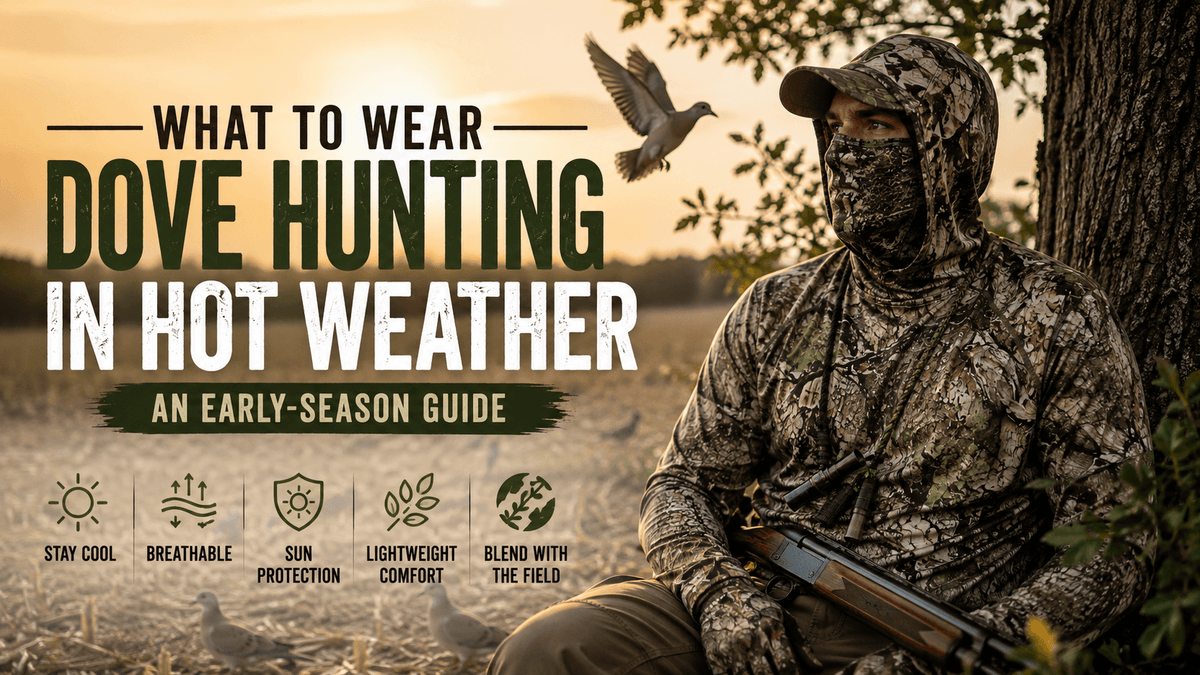
Depending on your location, early dove season can still bring genuinely hot conditions.
You may spend hours sitting in an exposed field with very little shade.
That changes the clothing equation considerably.
Heavy hunting jackets and insulated camouflage that make sense later in the year can quickly become uncomfortable.
Instead, early-season clothing should generally focus on three things:
breathability, lightweight coverage, and freedom of movement.
What Should You Wear for Opening Dove Season?
You don't need an elaborate clothing system.
A practical setup can be surprisingly simple.
Lightweight Long-Sleeve Hunting Shirt
A breathable long-sleeve shirt provides useful coverage without requiring a heavy outer layer.
For exposed fields, long sleeves can also reduce the amount of skin constantly exposed to direct sunlight.
Look for fabric that feels lightweight and doesn't become excessively heavy when damp with sweat.
Camouflage or Neutral Colors
Dove hunting doesn't always require full head-to-toe camouflage.
But you generally don't want to stand out dramatically from your surroundings.
Colors such as:
- Olive
- Brown
- Tan
- Gray
- Muted green
can work well depending on your hunting location.
Camouflage becomes more useful when you're sitting against brush, trees, or other natural cover.
Lightweight Pants
Heavy insulated hunting pants are usually unnecessary during early season.
Choose something comfortable enough for sitting but durable enough for the terrain you'll be walking through.
Hat
A hat can serve two purposes.
It provides some protection from direct sunlight while also reducing the visibility of your head and face.
Comfortable Footwear
Opening-day conditions vary enormously.
Some hunters walk relatively short distances across dry agricultural fields.
Others encounter mud, wet grass, uneven terrain, or thick vegetation.
Choose footwear based on the actual field rather than simply wearing your heaviest hunting boots.
Does Camouflage Matter on Opening Day?
It can.
Doves approaching a field often have a clear view from above.
A hunter sitting in the open can create an obvious human silhouette.
Camouflage helps reduce that contrast.
But there's something equally important:
Movement.
You could be wearing an excellent camouflage pattern and still attract attention if you're constantly standing, turning, or moving your arms.
Whenever possible, use existing cover.
Sit near:
- Brush
- Trees
- Tall vegetation
- Fence lines
- Shadows
Then keep unnecessary movement to a minimum as birds approach.
Your camouflage works best when you give it a good background to work against.
Match Your Camo to the Field
Not every dove field looks the same.
This is where choosing camouflage based purely on appearance can go wrong.
Imagine two hunting locations.
One is a dry harvested field surrounded by brown vegetation.
The other is bordered by dense green timber.
The same camouflage pattern won't necessarily perform equally well in both locations.
For dry environments, muted:
brown + tan + gray
can make sense.
Around wooded edges:
bark + branches + muted green
may provide a more natural match.
The objective isn't to wear the most complicated pattern available.
It's to avoid looking dramatically different from what's behind you.
Don't Overdress for Early Season
More hunting gear doesn't automatically mean better hunting.
For opening-day dove hunts, overdressing can actually become a distraction.
If you're hot and uncomfortable, you'll probably:
- Move around more
- Adjust your clothing
- Leave your position more frequently
- Lose concentration
That's why lightweight hunting clothing can have an indirect concealment benefit.
When you're comfortable, it's easier to remain still.
And remaining still matters when birds approach.
Prepare Your Hunting Clothing Before Opening Day
Don't wait until the morning of your hunt to pull your hunting clothing out of storage.
A few days beforehand, check:
Fit
Make sure you can comfortably shoulder your shotgun.
Raise both arms.
Rotate your shoulders.
Nothing should feel excessively tight through the upper back or arms.
Condition
Look for damaged seams, broken zippers, or other issues.
Comfort
If the forecast is warm, ask yourself whether the clothing is genuinely appropriate for several hours outdoors.
Camouflage
Consider where you'll actually be sitting.
Your hunting location should influence which pattern or color you choose.
What Else Should You Prepare?
Clothing is only one part of opening-day preparation.
Depending on local regulations and your hunting setup, your checklist may include items such as:
- Hunting license
- Required migratory-bird registrations or permits
- Appropriate ammunition
- Eye protection
- Hearing protection
- Water
- Sunscreen
- Insect protection
- Small hunting bag
- Cooler
- Dove decoys
Check current state and federal requirements before heading out.
Regulations regarding seasons, hunting hours, limits, legal methods, and ammunition can vary.
Morning vs. Afternoon Dove Hunting
Opening day can involve long periods outdoors, but conditions change considerably throughout the day.
Morning
Early mornings are usually cooler.
A lightweight long-sleeve layer may feel comfortable without additional insulation.
As the sun rises, temperatures can increase quickly.
Midday
This is often when lightweight, breathable clothing becomes most valuable.
If you're hunting an exposed field, shade may be limited.
Late Afternoon
Temperatures may begin falling again while bird activity changes.
A lightweight hunting setup gives you flexibility without forcing you to carry heavy clothing all day.
Don't Forget Hydration
Hunters spend a lot of time thinking about firearms, ammunition, camouflage, and decoys.
Water sometimes becomes an afterthought.
It shouldn't.
Early-season dove hunting can involve prolonged exposure to heat, especially when you're walking between locations or retrieving birds.
Bring enough water for the conditions and length of your hunt.
This is particularly important during afternoon hunts.
Opening Day Is About Preparation, Not Complexity
It's easy to overcomplicate dove hunting.
You don't necessarily need an enormous collection of specialized equipment.
A solid opening-day setup focuses on the fundamentals:
Know the regulations.
Scout the field.
Understand where birds are moving.
Choose a good position.
Wear clothing appropriate for the weather.
Stay still when birds approach.
Everything else builds on those basics.