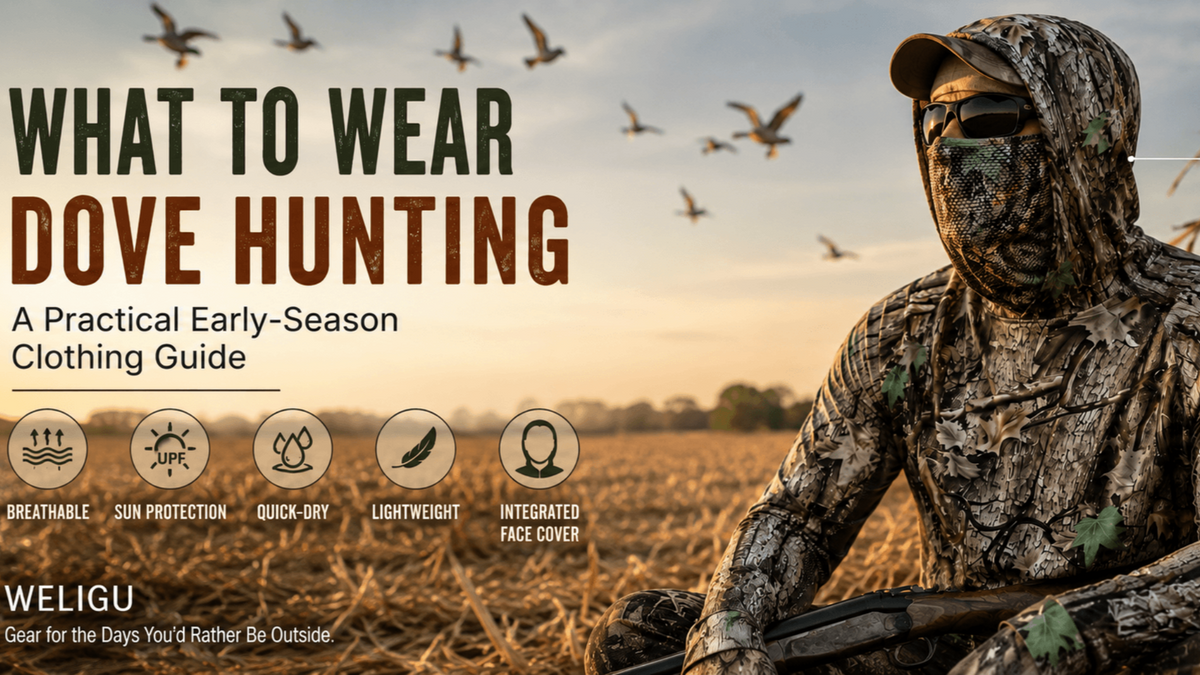
What to Wear Dove Hunting: A Practical Early-Season Clothing Guide
Dove Hunting Often Means Hunting in the Heat
Dove hunting often involves sitting near harvested fields, watering areas, tree lines, or other relatively open terrain. Shade may be limited, and depending on where you hunt, heat and humidity can become more noticeable as the morning progresses.
That makes lightweight clothing especially useful.
Instead of building your outfit around warmth, think about:
- Breathability
- Moisture management
- Sun coverage
- Freedom of movement
- Lightweight fabric
You can always bring a light layer for a cooler morning. Once the sun is up, however, your main hunting shirt needs to be comfortable on its own.
Start With a Lightweight Dove Hunting Shirt
For warm-weather dove hunting, the shirt is one of the most important parts of your setup.
Heavy fabric may feel fine while you are standing beside the truck before sunrise. After sitting in the sun or walking across a field, it can become a different story.
A good dove hunting shirt should feel light enough for warm conditions while still giving you practical coverage.
Look for breathable material that does not feel restrictive around the shoulders or arms.
That matters because dove hunting involves plenty of upper-body movement. You may spend long periods sitting relatively still, followed by a quick mount and swing when birds appear.
Your clothing should not get in the way of that movement.
A simple test before hunting is to put on your shirt and move your arms through the same range of motion you would use in the field.
If the fabric pulls noticeably across your shoulders, feels tight under the arms, or rides up every time you raise your elbows, it may become distracting during a long hunt.
Long Sleeves Can Make Sense Even on Hot Days
Short sleeves might seem like the obvious choice when temperatures are high.
But dove hunters often spend considerable time exposed to direct sunlight.
A lightweight long-sleeve shirt provides additional coverage across your arms and shoulders without necessarily adding much warmth if the fabric is breathable.
That can be particularly useful when you are hunting an open field with limited shade.
Long sleeves can also provide a layer between your skin and:
- Dry vegetation
- Brush
- Dust
- Insects
The important distinction is lightweight long sleeves.
A heavy cotton shirt and a breathable performance hunting shirt can feel completely different under the same conditions.
Breathability Matters More Than Insulation
During early dove season, you are usually trying to release heat rather than retain it.
That makes breathability one of the first characteristics to consider when choosing a hunting shirt.
Performance fabrics designed for warm weather can help heat and moisture move away from the body more effectively than heavier materials.
This becomes especially noticeable when you alternate between activity and sitting.
You may walk several hundred yards carrying your gear, get warm along the way, then sit relatively still for an extended period.
A breathable shirt that handles moisture reasonably well can make that transition considerably more comfortable.
Quick-Dry Fabric Helps With Sweat and Humidity
Warm-weather hunting and sweat tend to arrive together.
There is no fabric that prevents you from sweating when the temperature climbs, but some fabrics handle moisture better than others.
Quick-drying materials are useful because they do not stay wet as long after you have been walking or setting up.
That matters on humid mornings when evaporation is already slow.
It also makes the shirt more versatile outside hunting season. The same lightweight, quick-dry qualities are useful for fishing, hiking, boating, camping, and other warm-weather outdoor activities.
For hunters who spend much of the early season outside, versatility is worth considering.
Think About Sun Protection
Sun exposure can be easy to underestimate during a hunt.
You are concentrating on birds, watching the field, talking with hunting partners, or waiting for the next flight. A few hours can pass quickly.
Meanwhile, your arms, shoulders, neck, and face may be exposed to direct sunlight.
This is another reason lightweight long sleeves can work well for dove hunting.
UPF-rated clothing can also provide additional protection for the areas covered by the fabric.
What Colors Should You Wear Dove Hunting?
Dove hunting does not always require the same camouflage setup you might choose for other hunts.
The right clothing depends heavily on where you are sitting.
A hunter positioned against dry grass and crop residue is dealing with a different background from someone sitting beneath trees along the edge of a field.
The goal is to avoid standing out unnecessarily against your surroundings.
Muted earth tones such as:
- Brown
- Tan
- Olive
- Gray
- Muted green
can work well in many environments.
Camouflage can also be useful when the pattern fits the surrounding vegetation.
Rather than asking whether one camouflage pattern is universally “best,” look at the actual environment where you plan to hunt.
Dry late-summer vegetation may call for something very different from a green wooded edge.
Match Your Camouflage to the Background
Camouflage works best when you think beyond the word “camo.”
Pattern, contrast, and color all matter.
A heavily green pattern may look appropriate in dense summer vegetation but stand out badly against a dry field. Likewise, a pale grass-oriented pattern may not blend naturally against dark timber.
Before the hunt, take a look at where you expect to sit.
Ask yourself:
What colors dominate the background behind me?
That is usually more useful than choosing a pattern because it looks impressive on a product page.
For early-season wooded edges and areas with visible bark, leaves, and branches, a natural woodland-style pattern can provide a practical option.
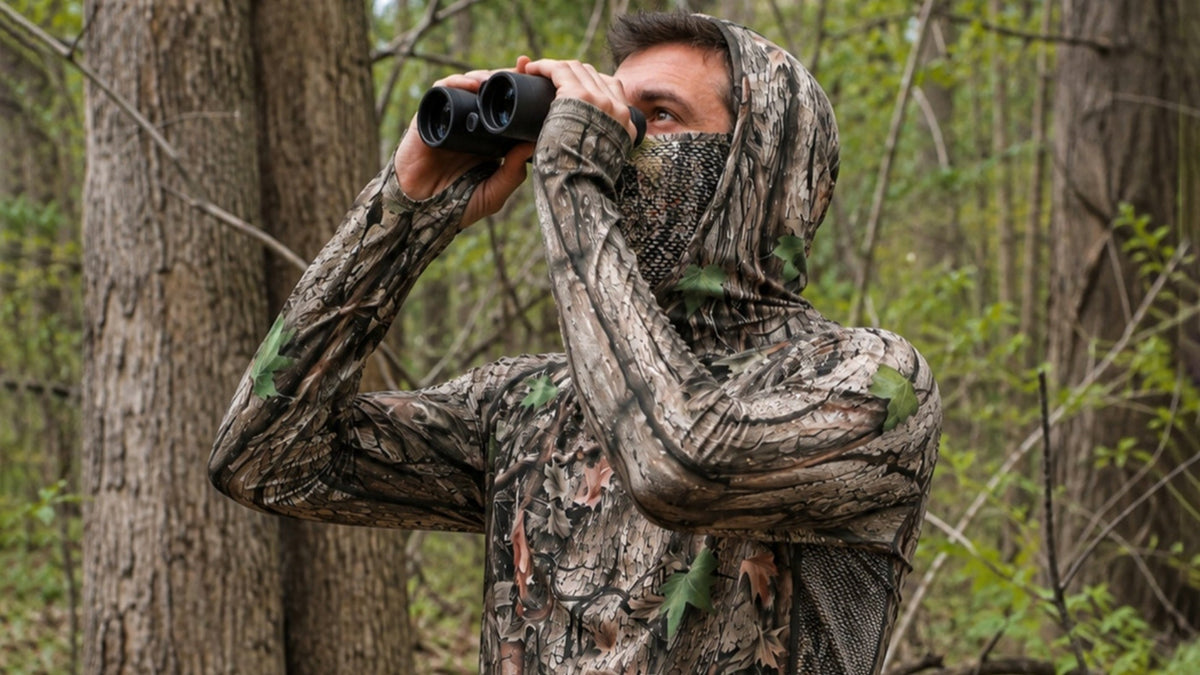
WELIGU's Camo Hunting Hoodie with Face Cover combines a lightweight hooded design with a nature-inspired camouflage pattern for warm-weather outdoor use.
What About a Hood and Face Cover?
A hooded hunting shirt can be useful during early season, provided the hood is lightweight.
The advantage is flexibility.
Keep it down when you do not need it. Pull it up when you want additional coverage around your head and neck.
An integrated face cover can offer another coverage option without requiring you to carry a separate face covering.
But comfort matters.
Anything covering your face should remain breathable enough for the conditions and should never interfere with vision, hearing, or safe firearm handling.
During particularly hot weather, you may simply choose not to use it.
Good hunting clothing should give you options rather than forcing you to use every feature all the time.
Don't Forget Your Pants
Your shirt gets much of the attention, but heavy pants can make an early-season hunt equally uncomfortable.
Lightweight outdoor pants usually make more sense than insulated hunting pants when temperatures remain high.
Choose something that allows you to sit, kneel, and walk comfortably.
Long pants also provide useful coverage when moving through:
- Dry grass
- Weeds
- Brush
- Insect-heavy areas
If you know you will be walking through thick vegetation, durability becomes more important than shaving off every possible ounce of fabric weight.
As with your shirt, choose based on the terrain.
A Hat and Good Sunglasses Go a Long Way
Dove hunters spend a lot of time looking toward the sky.
That alone makes eye comfort worth considering.
A brimmed hat helps provide some shade, while suitable sunglasses can reduce glare and make long periods outdoors more comfortable.
Make sure your eyewear does not interfere with shooting and provides appropriate protection for the activity.
These may seem like small additions compared with camouflage or hunting clothing, but on a bright September afternoon they can be some of the pieces you appreciate most.
Bring Water Before You Think You'll Need It
Clothing can help you stay more comfortable in warm conditions, but it cannot solve heat on its own.
Bring enough water.
This is especially important if you are walking any meaningful distance while carrying a shotgun, shells, stool, decoys, cooler, or other equipment.
If temperatures are unusually high, consider whether the conditions are appropriate for the length and intensity of hunt you have planned.
Pay attention to how you feel rather than trying to push through excessive heat.
There will always be another hunt.
Don't Forget Hunter-Orange Requirements
Visibility requirements vary significantly depending on state, season, location, and the type of hunting taking place.
Do not assume camouflage alone is appropriate simply because you are hunting doves.
Check the current regulations from the wildlife agency in the state where you plan to hunt before heading out.
This becomes particularly important when different hunting seasons overlap.
Your camouflage choice should never take priority over legal visibility requirements or basic hunting safety.
A Simple Early-Season Dove Hunting Outfit
You do not need to make the clothing side of dove hunting complicated.
For many warm-weather conditions, a practical setup might look like this:
Upper body:
Lightweight, breathable long-sleeve hunting shirt
Lower body:
Lightweight outdoor pants appropriate for the terrain
Head:
Brimmed hat or hunting cap
Eyes:
Appropriate protective sunglasses or shooting glasses
Feet:
Comfortable boots or outdoor footwear suited to the ground conditions
Optional:
Lightweight removable layer for a cool morning
Add any legally required visibility equipment and adjust the setup according to local weather and terrain.
That's really it.
Comfort Helps You Focus on the Hunt
Dove hunting can move from quiet to fast in a matter of seconds.
For several minutes, nothing happens.
Then birds appear and suddenly you are standing, mounting the shotgun, tracking movement, and making decisions quickly.
The last thing you want to be thinking about is a shirt sticking to your back or pulling across your shoulders.
That is why good early-season hunting clothing tends to be fairly simple.
It breathes.
It moves.
It provides useful coverage.
And eventually, you stop noticing it.
That is usually exactly what you want.