What to Wear Turkey Hunting: A Practical Guide to Clothing, Camo & Comfort
1. Start With a Lightweight, Breathable Hunting Shirt
For many spring hunts, your upper layer is one of the most important pieces of clothing.
A good turkey hunting shirt should provide enough coverage to help you blend in without becoming uncomfortable as temperatures rise.
Look for features such as:
- Lightweight fabric
- Breathability
- Moisture-wicking or quick-drying performance
- Long sleeves
- Comfortable range of motion
- A camouflage pattern appropriate for your surroundings
This isn't just a product-spec checklist.
New turkey hunters frequently ask experienced hunters what clothing they actually need, and lightweight, breathable, quick-drying camo is a recurring recommendation—particularly when temperatures can change significantly throughout the hunt.
2. Use Layers Instead of One Heavy Piece
Spring weather can be unpredictable.
A chilly morning can turn surprisingly warm by midday, especially after you've been walking, setting up, and moving between locations.
That's why layering makes more sense than relying on one heavy hunting jacket.
A simple system might look like this:
Cool morning:
Light base layer → hunting shirt or hoodie → optional outer layer
Warmer afternoon:
Base layer → lightweight hunting shirt
Hunters discussing spring turkey clothing frequently recommend exactly this approach: start with lightweight camo and add layers underneath as conditions require.
This also makes your hunting clothes more versatile.
Instead of owning a completely different outfit for every temperature, you can adjust the layers underneath your camo outer layer.
3. Cover Your Face and Hands
Your shirt and pants may blend into the woods perfectly while your face and hands remain obvious patches of exposed skin.
For turkey hunting, that's worth thinking about.
The NWTF specifically recommends covering the face and hands, while turkey hunters commonly use some combination of a face mask, hood, hat, and gloves.
There are several ways to do it:
Face mask
Simple and easy to remove.
Face paint
Minimal gear, but not everyone enjoys wearing or removing it.
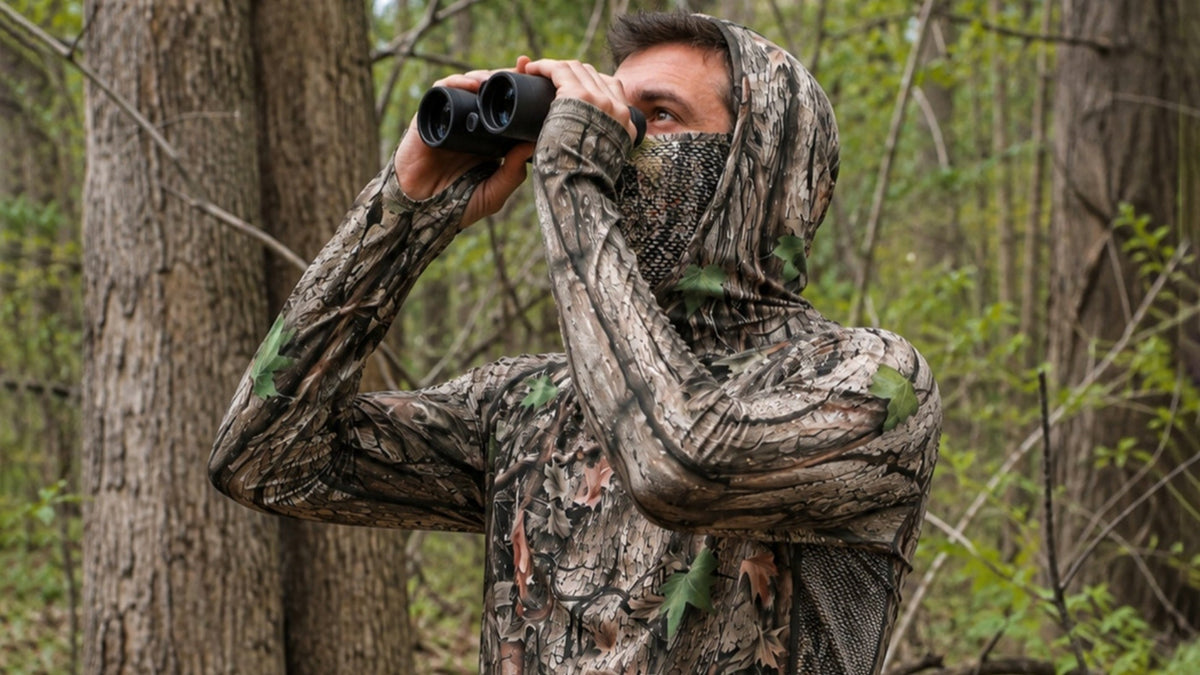
Hood with integrated face covering
Keeps the face covering attached to your shirt so there's one less separate piece to remember.
Gloves
Help conceal your hands, particularly when calling or repositioning.
The best option is whichever one you'll actually wear comfortably.
If a face covering is so hot or restrictive that you're constantly adjusting it, you're creating another problem: movement.
Modern turkey-oriented hunting tops increasingly combine lightweight fabric, a hood and built-in face covering for exactly this reason.
4. Does Your Camo Have to Match?
No.
Your shirt, pants, gloves and hat don't necessarily need to come from the same camouflage collection.
This question comes up surprisingly often among hunters.
Experienced turkey hunters report successfully mixing different camo patterns and earth-tone clothing. The more consistent advice is to choose colors and patterns that fit the environment and avoid creating an obvious human silhouette.
For example, you might wear:
- A bark-and-leaf camo top
- Brown or muted pants
- A camouflage hat
- A lightweight face covering
- Dark or camo gloves
That's perfectly reasonable.
Your surroundings matter more than whether the pattern printed on your sleeves exactly matches the pattern printed on your pants.
5. Choose Camo for Where You're Actually Hunting
There isn't one universally "best" turkey hunting camo.
Look around your hunting area.
Early Spring Woods
Before full green-up, forests may contain plenty of:
- Gray tree trunks
- Brown leaves
- Bare branches
- Muted vegetation
A pattern dominated by bark, branches and brown earth tones can make sense here.
Later Spring
As vegetation fills in, more green in the pattern may help the clothing fit the environment.
Field Edges
If you're setting up along brush, hedgerows or field edges, look at the background where you'll actually be sitting—not simply the open field in front of you.
Hunters commonly adjust their camouflage based on local vegetation and the stage of the season rather than following one universal pattern recommendation.
In other words:
Match the habitat, not the catalog.
6. Don't Forget Your Backdrop
You can wear excellent camouflage and still stand out if you're sitting in the wrong place.
A solid backdrop helps break up your outline.
A large tree, shaded brush or dense vegetation behind you can make a meaningful difference. Experienced hunters frequently emphasize setup, shadows and staying still alongside clothing choice.
Before settling in, ask yourself:
What does the turkey see behind me?
Not just:
What camo am I wearing?
That's an easy habit to develop, and it doesn't cost anything.
7. What About Hunting Pants?
Your pants should follow the same general rule as your shirt:
comfortable, quiet, practical and appropriate for the weather.
Full camouflage is certainly an option, but some hunters successfully pair a camo upper layer with brown, tan, olive or other subdued earth-tone pants.
Consider:
- How much walking you'll do
- Temperature
- Brush and terrain
- Insects
- Whether you'll encounter wet vegetation
- How long you'll be sitting
For warm-weather hunts, lightweight pants can be much more comfortable than heavy insulated hunting pants.
8. What Shoes Should You Wear Turkey Hunting?
Your footwear depends heavily on terrain and weather.
Dry ground and moderate walking may call for comfortable hiking or hunting boots.
Wet spring conditions may make waterproof boots more useful.
Whatever you choose, prioritize:
traction + comfort + weather protection.
Turkey hunting can involve more walking than expected, and uncomfortable footwear becomes noticeable very quickly once you're covering ground.
9. What Not to Wear Turkey Hunting
Turkey hunting clothing doesn't need to be expensive, but there are a few things worth avoiding.
Try not to wear clothing that is:
- Uncomfortably heavy for the conditions
- Extremely noisy when you move
- Restrictive when sitting or raising your arms
- Poorly suited to the surrounding vegetation
- Difficult to layer
- So uncomfortable that you're constantly adjusting it
And don't assume that buying the most expensive camo automatically makes you better concealed.
Turkey hunters repeatedly make the same point:
Movement can give you away regardless of what pattern you're wearing.
Comfort therefore becomes part of concealment.
If you're comfortable, it's easier to sit quietly and stay still.
10. A Simple Turkey Hunting Clothing Checklist
You don't need to overcomplicate your first setup.
A practical clothing system can be:
Lightweight camo hunting shirt or hoodie
For upper-body concealment and coverage.
Base layer
Add or remove depending on temperature.
Hunting pants or subdued earth-tone pants
Choose according to terrain and weather.
Face covering
Especially useful when hunting without a blind.
Gloves
For hand concealment.
Hat or hood
Adds coverage around your head.
Comfortable hunting boots
Match them to terrain and moisture conditions.
Packable outer layer
Useful when rain or colder temperatures are possible.
That's enough to get started.
You can refine your system after spending more time in the woods.
Do You Really Need Expensive Turkey Hunting Clothes?
No.
Good turkey hunting clothing doesn't have to be expensive.
In fact, community discussions include plenty of experienced hunters using mismatched camo, inexpensive clothing and older patterns successfully.
Prioritize function first:
Does it blend reasonably well?
Is it comfortable?
Can you sit still in it?
Does it handle the weather?
Does it cover what needs to be covered?
If the answer is yes, you're already covering the fundamentals.